能楽
Nōgaku
- 👥Japanese
- 🗣︎Japanese
- 🌐Japan
Nōgaku theatre had its heyday in the fourteenth and fifteenth centuries, but actually originated in the eighth century when the Sangaku was transmitted from China to Japan. At the time, the term Sangaku referred to various types of performance featuring acrobats, song, and dance as well as comic sketches. Its subsequent adaption to Japanese society led to its assimilation of other traditional art forms.
Today, Nōgaku is the principal form of Japanese theatre and has influenced the puppet theatre as well as the more-recent Kabuki. Often based on tales from traditional literature, Nōgaku theatre integrates masks, costumes, and various props in a dance-based performance. Moreover, this theatre requires highly trained actors and musicians.
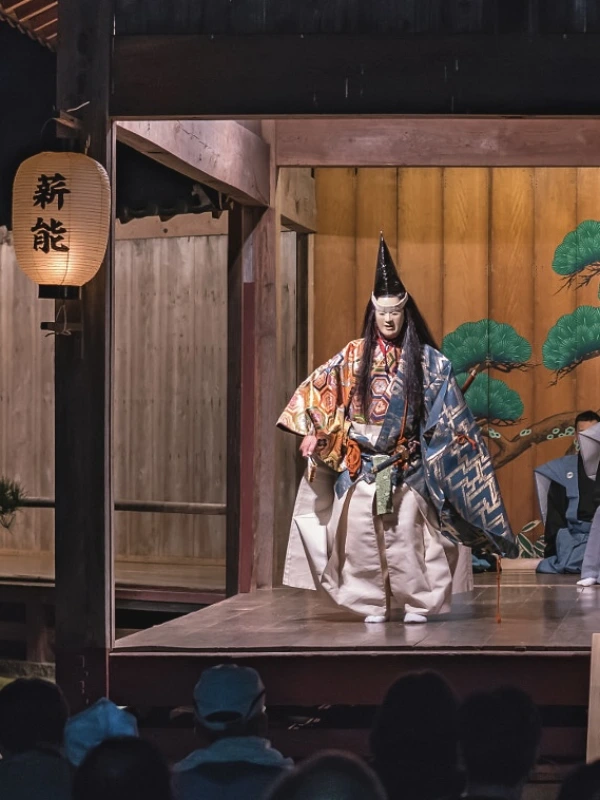
Nōgaku encompasses two types of theatre: Noh and Kyōgen, which are performed in the same space. The stage projects into the audience and is linked by a walkway to a “hall of mirrors” backstage. In Noh, emotions are represented by stylised conventional gestures. The hero is often a supernatural being who takes on human form to narrate a story. The distinctive masks for which Noh is renowned are used for the roles of ghosts, women, children, and old people.
Kyōgen, on the other hand, relies less on the use of masks and is derived from the humorous plays of the Sangaku, as reflected in its comic dialogue. The text is written in ancient language and vividly describes the ordinary people of the twelfth to sixteenth centuries.